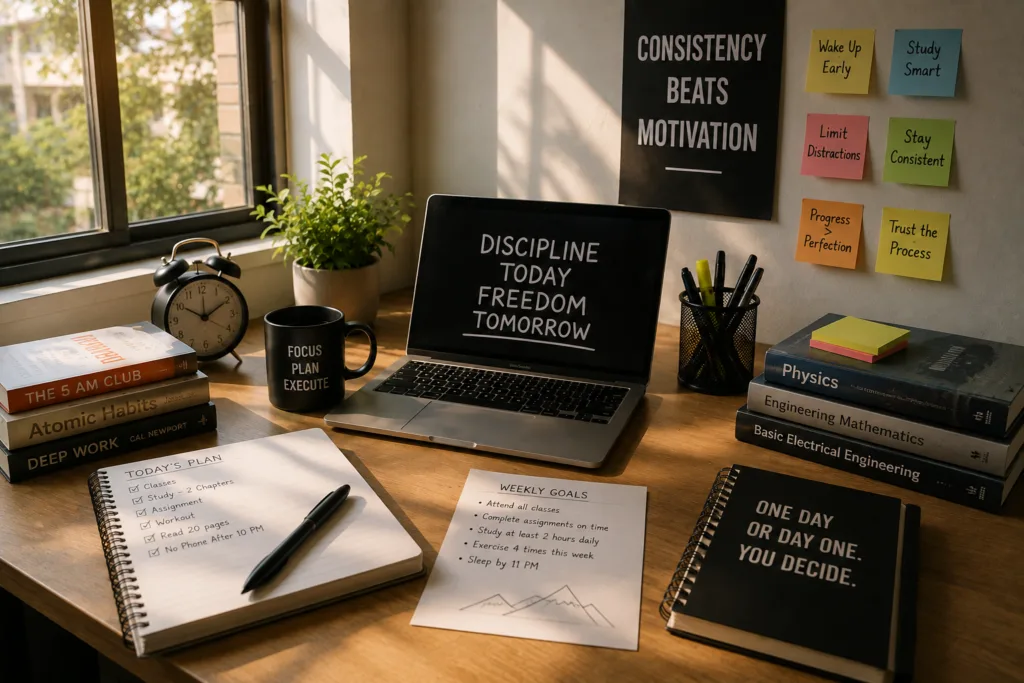
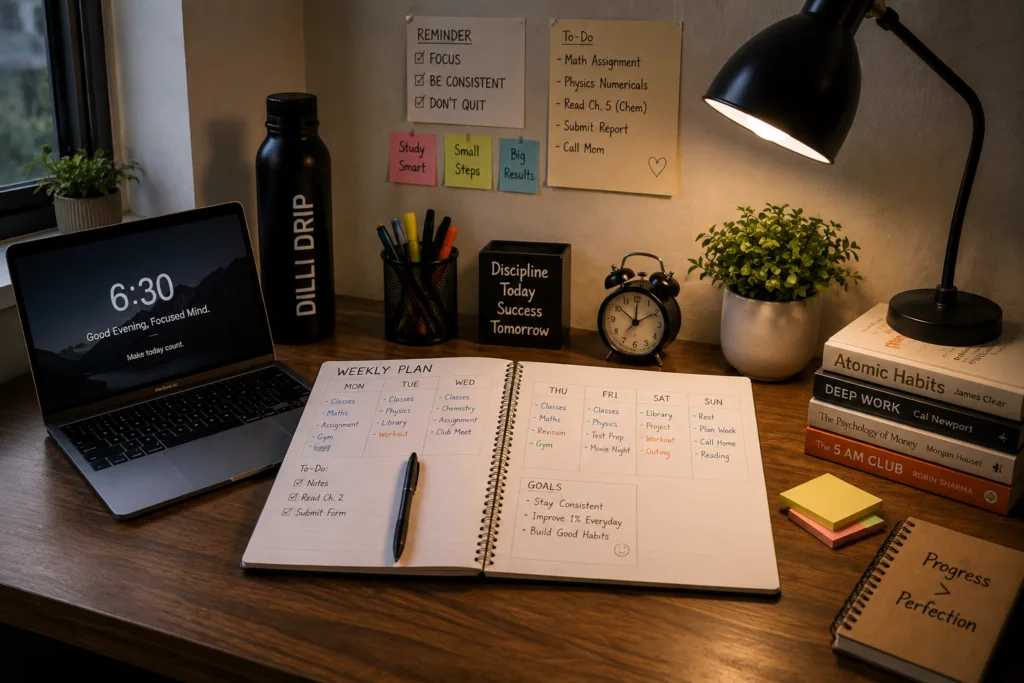
Daily Routine for Students: A Simple Routine That Actually Works
A good daily routine for students should make college life easier, not turn every day into a strict timetable.
Between classes, assignments, exams, friends, social media, exercise, and personal responsibilities, it can feel like there are never enough hours in the day.
The answer isn’t necessarily waking up at 5 AM or studying for ten hours.
Instead, a useful routine gives your day some structure while leaving enough room for rest, unexpected plans, and things you genuinely enjoy.
This guide explains how to build a realistic student routine that balances college, studying, sleep, exercise, social life, and personal time.
Why Do Students Need a Daily Routine?
Without some structure, an entire day can disappear surprisingly quickly.
You might plan to study after college, spend an hour scrolling through your phone, take a long break, and suddenly realise that it is midnight.
A routine provides a basic framework for the day.
It helps you decide when to study, when to rest, when to exercise, and when to handle smaller responsibilities.
More importantly, your schedule doesn’t have to be perfect.
Consistency matters much more than following exactly the same timetable every day.
1. Start Your Morning Without Rushing
The first part of the day can influence how organised everything feels afterwards.
A complicated morning routine isn’t necessary. A few simple habits can be enough to get moving.
Try starting with these steps:
Wake up at a reasonably consistent time
Drink some water
Make your bed
Wash up and get ready
Eat something
Check your schedule for the day
Social media is best avoided immediately after waking up.
A few minutes of scrolling can easily become half an hour before you’ve even started your day.
Don’t Force an Extremely Early Wake-Up
Waking up early is useful only when you’re getting enough sleep.
Someone who regularly sleeps at 1 or 2 AM will probably struggle if they suddenly start waking up at 5 AM.
Build your morning around a sleep schedule that you can realistically maintain.
2. Plan Your College Day Before It Starts
A little planning can prevent a lot of last-minute stress.
Before leaving for college, check your classes, assignments, deadlines, and anything important happening that day.
A simple plan could look like this:
College: 9:00 AM – 3:00 PM Assignment: Finish history notes Study: One hour of mathematics Exercise: 30 minutes Personal: Call a friend or relax Sleep: 11:00 PM
Not every minute needs to be scheduled.
Leave some flexibility for unexpected college work, travel, conversations, and breaks.
3. Use College Hours Properly
College itself can become one of the most productive parts of your day.
Paying attention during lectures can reduce the amount of work you need to repeat later.
Write down important concepts, questions, deadlines, and topics that need more attention.
Free periods can also become useful pockets of time.
You don’t have to spend every break studying. Even 20–30 minutes spent reviewing notes or completing a small task can reduce your evening workload.
The goal isn’t to turn college into a nonstop productivity session.
Use those hours intelligently so there is less academic pressure waiting for you at home.
4. Don’t Wait Until You Feel Motivated to Study
Motivation is unreliable.
Some days you’ll feel ready to study. On other days, opening a textbook can feel like the hardest task in the world.
A better approach is to create a small starting rule.
For example:
“I’ll study for just 20 minutes.”
Once you begin, continuing often becomes easier.
Large assignments can also be divided into smaller tasks.
Instead of writing:
Study chemistry
write:
Read Chapter 4 Make five notes Solve questions 1–10
A smaller task feels easier to start.
5. Create a Realistic Study Block
Your study schedule should match your concentration level.
For many students, one focused hour is more useful than three hours of distracted studying.
Try a simple structure:
50 minutes: Focused study 10 minutes: Break
During the focused period, keep your phone away from the desk.
After several rounds, take a longer break.
Students who prefer shorter sessions can try 25 minutes of work followed by a five-minute break.
There isn’t one study method that works for everyone. Test different durations and keep the approach that helps you concentrate.
6. Control Your Phone Instead of Fighting It
For many students, the phone becomes the biggest source of distraction.
Completely removing it from your life isn’t necessary.
Instead, create simple boundaries around when you use it.
During study sessions:
Turn off unnecessary notifications
Use Do Not Disturb
Keep social apps closed
Put your phone across the room
Avoid checking messages after every small task
Planned breaks can still include social media and messages.
The important difference is that you decide when to check your phone, rather than allowing every notification to interrupt you.
7. Make Time for Exercise
Exercise doesn’t require spending two hours at the gym.
A short walk, home workout, cycling session, sport, or gym visit can fit into a busy student schedule.
Even 20–30 minutes of movement can give you a useful break from sitting and studying.
Choose an activity that you actually enjoy.
If running feels miserable, there is no reason to build your entire routine around running.
Consistency becomes much easier when the activity fits your lifestyle.
8. Don’t Skip Your Evening Break
A productive routine needs downtime.
After classes and studying, give yourself some time to do something unrelated to academics.
Watch an episode of a show. Listen to music. Meet friends. Play a game. Go for a walk. Sit at a café.
The activity itself isn’t the most important part.
Your brain needs some distance from constant academic work.
Trying to stay productive every minute can eventually make your routine exhausting instead of sustainable.
9. Finish Small Tasks Before They Become Big Problems
Small responsibilities are easy to ignore.
Laundry, replying to important messages, organising notes, preparing tomorrow’s bag, and checking deadlines may each take only a few minutes.
Together, however, these tasks can create unnecessary stress when they are ignored for several days.
Spend 15–20 minutes in the evening clearing smaller responsibilities.
Tomorrow becomes easier when today’s small problems aren’t waiting for you.
Comfort That Fits a Minimal Lifestyle
A calmer room works even better when the things around you feel comfortable and practical.
Dilli Drip’s relaxed everyday pieces are designed for comfort, making them suitable for studying, relaxing, travelling, or spending a slow day at home.
₹1,299Original price was: ₹1,299.₹799Current price is: ₹799. Incl. of taxes
S - Out of StockS
MM
LL
XLXL
XXL - Out of StockXXL
10. Protect Your Sleep
Sleep is one of the easiest parts of a student routine to sacrifice.
An assignment runs late. Then you start scrolling. One video becomes five, and suddenly it is 2 AM.
The following morning starts with low energy.
A consistent sleep schedule can make the rest of your routine much easier to maintain.
Try to keep your bedtime and wake-up time reasonably consistent, including on weekends.
Create a Simple Night Routine
About 30–60 minutes before bed:
Finish your important tasks
Prepare your bag for tomorrow
Put your phone away
Dim bright lights
Set your alarm
Get into bed at a consistent time
The objective isn’t perfection.
You simply want your brain to recognise that the day is coming to an end.
11. Prepare Tomorrow Before Going to Sleep
Five minutes of preparation can save you from morning chaos.
Check tomorrow’s timetable.
Pack your college bag.
Choose what you need for the next day.
Review your most important task.
Set your alarm.
This small habit creates a cleaner starting point for the following morning.
It also reduces the number of decisions you need to make immediately after waking up.
12. Build Your Routine Around Priorities
Not every task deserves the same amount of attention.
Start by identifying your three most important responsibilities for the day.
For example:
Attend all classes
Finish an assignment
Study mathematics for one hour
Everything else can fit around those priorities.
This approach becomes especially useful during busy weeks because you can still make progress when your schedule changes.
A routine should support your priorities, not become another source of stress.
13. Leave Space for Friends and Social Life
College isn’t only about grades.
Friendships, conversations, events, hobbies, and new experiences are also part of the college experience.
A healthy daily routine for students should leave room for social life.
You don’t need to accept every invitation.
At the same time, spending every evening alone at your desk isn’t automatically productive.
Balance matters.
14. Use a Weekly Reset
Daily routines become easier when you also have a weekly reset.
Choose one day each week to look at everything coming up.
Check:
Upcoming assignments
Exams
College events
Personal commitments
Laundry
Room organisation
Budget
Exercise plans
After that, decide where your study time will go.
A 20–30 minute weekly review can prevent you from discovering an important deadline at the last minute.
Sample Daily Routine for Students
Here’s an example of a balanced college day:
Time
Activity
7:00 AM
Wake up and get ready
7:30 AM
Breakfast
8:00 AM
Travel to college
9:00 AM – 3:00 PM
Classes and college
3:30 PM
Lunch / travel home
4:00 PM
Rest
4:30 PM
Study block
5:30 PM
Exercise / walk
6:15 PM
Shower and snack
7:00 PM
Assignment / focused study
8:30 PM
Dinner
9:00 PM
Friends, gaming, music, or personal time
10:00 PM
Prepare for tomorrow
10:30 PM
Relax
11:00 PM
Sleep
Your schedule doesn’t need to match these exact times.
The structure matters more than the clock.
Common Routine Mistakes Students Make
Making the Schedule Too Strict
A timetable with every minute planned can become difficult to follow.
Leave some room for unexpected events and changes.
Trying to Study All Day
Long hours don’t automatically mean effective studying.
Quality and concentration matter more than simply counting hours.
Sacrificing Sleep
Staying awake all night may help you finish one task, but the following day can become much harder.
Keeping Your Phone Beside You
Even without opening it, notifications can interrupt your attention.
Copying Someone Else’s Routine
Your friend’s schedule might work perfectly for them and completely fail for you.
Build around your own classes, commute, energy levels, responsibilities, and goals.
Build Your Everyday College Rotation
Your study space should help you feel comfortable and confident throughout a long college day.
Dilli Drip’s relaxed streetwear is designed for everyday movement, making it easy to transition from studying at home to college, cafés, or casual hangouts.
₹1,299Original price was: ₹1,299.₹799Current price is: ₹799. Incl. of taxes
S - Out of StockS
MM
LL
XLXL
XXL - Out of StockXXL
How to Stay Consistent With Your Routine
The hardest part isn’t creating a timetable.
Following it after the initial motivation disappears is usually the bigger challenge.
Start with three simple habits instead of changing your entire lifestyle overnight.
For example:
Sleep at a consistent time
Complete one focused study session
Prepare tomorrow’s essentials before bed
Once those habits become normal, add another one.
Small improvements are easier to maintain than a complete lifestyle overhaul.
What to Do When Your Routine Falls Apart
It will happen.
You may sleep late, miss a study session, spend too much time online, or have a completely unproductive day.
Don’t try to compensate by creating an extreme schedule the next day.
Instead, restart with the next available action.
A missed study session can simply become tomorrow’s first task.
A late night doesn’t mean you have to abandon your entire sleep schedule.
Even a messy room can be handled with ten minutes of cleaning.
One bad day doesn’t destroy a routine.
Giving up because of one bad day does.
Frequently Asked Questions
What is the best daily routine for students?
The best routine balances classes, focused study, sleep, exercise, personal responsibilities, and free time. Flexibility is also important because college schedules can change.
How many hours should a student study every day?
There isn’t one number that works for everyone. Required study time depends on your course, workload, deadlines, and learning speed. Focused study is generally more useful than simply sitting at a desk for long hours.
How can I stop procrastinating?
Start with a very small task. Instead of planning to finish an entire chapter, commit to reading a few pages or studying for 20 minutes. Beginning is often easier when the task feels manageable.
Should students wake up early?
Only when an early schedule fits their lifestyle and still allows enough sleep. Waking up early isn’t automatically productive.
How can I balance studying and social life?
Plan your important academic tasks first, then protect some time for friends, hobbies, entertainment, and rest. A balanced schedule is easier to maintain than an all-work routine.
Final Thoughts
A useful daily routine for students isn’t about becoming productive every minute.
It is about knowing what deserves your attention and creating enough structure to get those things done.
Start with the basics: consistent sleep, regular meals, healthy lifestyle, college responsibilities, focused study, movement, and genuine free time.
From there, adjust the routine based on what actually works for you.
You don’t need a perfect timetable.
What you need is a routine that you can realistically follow on an ordinary Tuesday—not just on the days when you feel motivated.
Build it slowly, keep it flexible, and focus on consistency over perfection.